
What is Relationship Anxiety and How To Overcome It
Relationship anxiety is a persistent feeling of worry, doubt or fear about your romantic relationship, even when nothing has actually gone wrong. It can show up as overthinking, reassurance seeking, jealousy, fear of abandonment, or shutting down. It is not a sign that something is wrong with you, or with your relationship. It is a nervous system response, often shaped by earlier experiences, and it can be eased with the right support.
About the author: Jennifer Roblin is the founder of Better Your Life and an Anxiety Specialist and Therapist. Having experienced and overcome anxiety herself, Jennifer brings both personal and professional experience to her work. She has appeared on BBC, ITV and Channel 4 and specialises in helping people overcome anxiety, panic attacks, burnout and public speaking fears. She has worked with clients aged 6 to 86, online and in person across the UK and beyond.
Falling in love is meant to feel safe, warm and steady. So why does it sometimes feel like the opposite? Why does a quiet evening with your partner make your chest tighten, or a slightly shorter reply send your mind into a spiral?
If that is familiar, you are not on your own. Relationship anxiety is one of the most common reasons people reach out to me. The good news is that this pattern is not permanent, and once we understand it, we can begin to gently change it.

What You Will Learn In This Article
- What relationship anxiety really is, and how it tends to show up
- Why it is a nervous system response rather than a personality flaw
- The common signs that it has started to shape your behaviour
- How your attachment style influences the way you love, trust and feel safe
- Practical tools, including the five love languages, that help calm anxiety in your relationship
- Gentle, root cause strategies for lasting change
What Is Relationship Anxiety?
Relationship anxiety is when your worry, doubt or fear is focused specifically on your romantic relationship. It might be a new relationship, where part of you keeps asking "is this really the right person for me?", or a long term relationship where you find yourself wondering whether the love is still there, or whether something is quietly going wrong.
It often feels like a low hum that never quite switches off. Trust feels fragile. Small things, like a slightly different tone of voice or a delayed reply, get blown into something much bigger by an anxious mind. You may end up seeking constant reassurance, or pulling back to protect yourself before anything has even happened.

Relationship Anxiety Is A Nervous System Response, Not A Flaw
Many of our clients arrive carrying a story about themselves that says they are needy, clingy, jealous or "too much". That story rarely belongs to them. It belongs to a nervous system that learnt, somewhere along the way, that closeness can come with rejection, criticism or unpredictability.
When your system has learnt that, it begins to scan for danger inside your relationships. Even the kindest, most steady partner can be experienced as a threat by a body that is on high alert. You can know with your head that your partner loves you, and still feel terrified they will leave. That is because the fear is not living in your thoughts. It is living in your body.
This is why logic alone often does not work. You cannot think your way out of a feeling that is being held in your nervous system. The work needs to happen in the body, in your patterns, and in the deeper beliefs that sit underneath.
What Causes Relationship Anxiety?
There is rarely a single cause. More often, several threads come together.
Early experiences play a big role. If love and care were inconsistent, conditional, or sometimes painful when you were small, your nervous system can hold a memory of that. It learns that closeness is wonderful and risky at the same time. As adults we can find ourselves recreating that uncertainty, even with a partner who is calm and reliable.
Past relationships matter too. Betrayal, a sudden ending, being made to feel "too much" or "not enough", can all leave a quiet imprint. The nervous system files these moments away as evidence that love hurts, and those files keep getting opened in new relationships.
Personal insecurities, unresolved emotional pain, and general anxiety about life can all add to the pattern. With around one in four people in the UK living with an anxiety disorder, it is no surprise that anxiety so often shows up inside our relationships too.
The Signs Of Relationship Anxiety
Relationship anxiety rarely announces itself clearly. It tends to creep in quietly, disguised as caring deeply, or wanting to "get things right". Many clients only realise it has been steering the relationship once we name it together.
Common signs include:
- Constantly seeking reassurance, asking "do you still love me?" or "are you angry with me?"
- Overthinking small details, replaying conversations and reading into tone
- A persistent fear of abandonment, even when nothing in the relationship suggests it
- Trying to read your partner's mind, or predict their mood
- Jealousy that feels much bigger than the situation
- Wanting to check their phone or messages for reassurance
- Pulling away or shutting down when closeness feels too much
- Picking fights without quite knowing why
- Finding it hard to enjoy good moments because you are bracing for them to end
None of these are character flaws. They are nervous system strategies trying to protect you from a feared loss. Once we understand that, the work shifts from blaming yourself to gently retraining your system to feel safe.
Attachment Styles And How They Shape Love
Attachment theory is one of the most helpful ways to understand relationship anxiety. It is not a label or a personality test. It is simply a description of how your nervous system has learnt to relate to closeness.
There are four main patterns:
- Secure attachment. Closeness feels safe. Independence feels safe. You can ask for what you need, offer support, and be alone without it feeling threatening.
- Anxious attachment. Closeness feels essential, but never quite enough. There is a constant quiet worry about whether your partner will stay, and a strong pull to seek reassurance.
- Avoidant attachment. Closeness can feel overwhelming. Independence feels safer. Intimacy can trigger a quiet need to pull away, even when the relationship is good.
- Fearful avoidant attachment. A mix of both. A strong wish for closeness alongside a strong fear of it. It can feel like wanting someone closer and pushing them away in the same breath.
Most relationship anxiety lives in the last three patterns. The encouraging part is that attachment is not fixed. It is learnt, which means it can be relearned. With consistent, calming experiences, and often with therapy, your system can move towards what we call earned secure attachment.
The Five Love Languages: A Practical Layer
One of the most useful pieces of work I do with couples sits alongside the nervous system piece. It is the idea of love languages, made famous by Gary Chapman in his book The Five Love Languages.
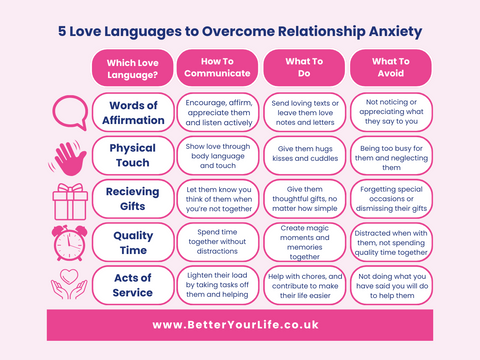
We tend to show love in the same way we like to receive it. But your partner may speak a completely different language. When that goes unnoticed, both of you can be making a real effort and still end up feeling unloved.
The five love languages are:
- Words of affirmation, such as kind words, encouragement and verbal appreciation
- Acts of service, such as cooking, tidying, running errands
- Receiving gifts, where small tokens carry meaning
- Quality time, undivided attention together
- Physical touch, from a hand on the back to a long hug
I once worked with a couple I will call Richard and Angela. Richard was frustrated because, in his words, he was not feeling loved. He showered Angela with hugs and kisses and felt he was doing everything to make her feel adored. Angela meanwhile felt smothered by his constant touch. On her side she was keeping the house warm and tidy, lighting candles, cooking his favourite meals, and felt deeply underappreciated.
Once we mapped their languages, it became clear. Richard's primary love language was physical touch and words of affirmation. Angela's was acts of service. They were both putting in huge effort. They were just speaking past each other. Naming it allowed them to both feel seen, and to start meeting each other where they actually were.
How To Overcome Relationship Anxiety: Strategies That Actually Work
The approaches below tend to make the biggest difference, because they speak to the nervous system and the relationship together, not just the thinking mind.
1. Slow Your Breath Before You Speak
When relationship anxiety spikes, your body moves into fight, flight or freeze. Calm conversation is almost impossible from that state. A simple practice is to breathe in for four, out for six, for two full minutes before responding to something that has triggered you. A longer out breath signals safety to your nervous system. This is not avoidance. It is making space for the real conversation, rather than the panicked one.
2. Notice The Story, Then Ask "Is This Fact Or Fear?"
Anxious thoughts often feel like the truth. They are not. When you notice yourself spiralling, pause and ask, "is this something my partner has actually said or done, or is this my anxiety predicting?" That small question begins to separate what is real from what is being projected by an activated system. Over time, the spirals shorten.
3. Communicate The Feeling, Not The Accusation
Anxiety often turns into criticism on the way out of our mouth. Try, "I am noticing some anxiety right now and I would love a moment of reassurance, even though I know logically you have done nothing wrong", rather than, "why did you not reply faster?" This protects the relationship while honouring what you feel.
4. Be More Compassionate, To Yourself And To Them
Sometimes your partner is just having a hard day. They may be withdrawn or quiet, and it may have nothing to do with you. Instead of seeking immediate reassurance, or telling yourself they have stopped loving you, take a few deep breaths and give them space. Break the habit of dissecting every action and word. Small gestures and throwaway comments can become huge under anxious scrutiny, when really they meant nothing.
5. Understand Your Core Beliefs And Values
Many of us are running on beliefs we picked up in childhood without ever choosing them. Working with an anxiety specialist to uncover those, and to identify your true values, can change the way you behave inside your relationship. In one couple I worked with, safety and security mattered hugely to her, while fun and spontaneity mattered most to him. Once they understood that, they could stop taking each other's behaviour so personally.
6. Learn Your Love Languages, Together
As in Richard and Angela's story, knowing how each of you naturally gives and receives love changes everything. Ask each other openly. Talk about which gestures land most. Then make a small effort to speak your partner's language as well as your own.
7. Reduce The Reassurance Loop
Reassurance feels like the answer in the moment, but too much of it actually feeds the cycle. The relief is short, and the worry comes back stronger. Try sitting with the discomfort for a few minutes before reaching out, and notice that it does pass. Your nervous system needs evidence that the feeling can move through you without you needing to act on it.
8. Build Daily Moments Of Calm In Your Body
Relationship anxiety lives in the body, so healing has to include the body. Walking, slow stretching, putting a hand on your chest, humming, splashing cold water on your face, or noticing five things you can see, can all bring your system back into a calmer state. The calmer you are at baseline, the less reactive you become inside the relationship.
9. Define The Relationship You Want
Hold a clear picture of the loving, trusting relationship you want to build. Knowing what you are working towards helps you align your day to day choices, and protects you from drifting into old patterns by default.
10. Work With The Root Cause, Not Just The Symptom
Relationship anxiety rarely starts in the current relationship. It usually starts much earlier. Therapy that works with the unconscious patterns and the nervous system, rather than only the surface thoughts, allows the original imprint to soften. This is where the most lasting change tends to happen, especially for people who have already tried talking, coping techniques or other approaches and still feel stuck.

FAQs About Relationship Anxiety
Is relationship anxiety normal?
Some worry in a relationship is part of being human. It becomes a problem when it is constant, much bigger than the situation, and starts to drive your behaviour. If it is affecting your sleep, your mood, or how you communicate with your partner, it is worth getting support.
Does relationship anxiety go away on its own?
For some people, it eases as trust grows. For others, especially those carrying fears from earlier relationships, it tends to stick around until the underlying pattern is addressed. The good news is that it responds very well to the right kind of work.
Can my partner help me with relationship anxiety?
A kind, patient partner is a huge support, but they cannot do the inner work for you. The most powerful thing they can do is hold steady while you build new responses. The most powerful thing you can do is take responsibility for the part of the pattern that lives in you.
What if my partner also has anxiety?
You can both work on it, individually or together. Many of the couples I see come in believing the relationship is the problem, and discover that anxiety is the real driver. Once you both understand it, you stop fighting each other and start tackling the pattern together.
How long does it take to overcome relationship anxiety?
It depends on how long the pattern has been there, and how willing you are to work with the root cause rather than only the surface thoughts. Many clients notice a real shift within a few sessions, with deeper change continuing over weeks and months as the nervous system learns to feel safer.
If You Would Like Further Support
Overcoming relationship anxiety is a journey that involves a combination of self awareness, body based practices, and often the support of a therapist who can help you reach the root of it. You can absolutely use these tools on your own, and you do not have to.
If you have already tried talking, coping strategies or other approaches and still feel stuck, working with an anxiety specialist can help you uncover the deeper pattern and finally let it settle. At Better Your Life, we work with the nervous system, the unconscious patterns and the root cause behind anxiety, online across the UK and beyond, as well as in person.
Other Resources
Read: Can Anxiety Cause Relationship Breakups? Warning Signs And How To Save Your Relationship
Download: Circle Of Control And Influence Worksheet
Download: Journaling Questions To Reduce Anxiety
Download: Window Of Tolerance Workbook
Originally posted: 15 March 2024 | Last updated: 24 May 2026